Pyrite lacks cleavage planes entirely due to its cubic crystal structure with uniformly strong atomic bonds. Instead of splitting along defined directions, it typically fractures with curved, shell-like breaks called conchoidal fracture. This distinctive feature, combined with its metallic luster and pale brass-yellow hue, helps distinguish pyrite from minerals with similar appearances but different structural behaviors.
You're examining a mineral sample in your geology lab, scratching your head at its contradictory traits. The metallic sheen and brassy color suggest pyrite, yet you're finding no trace of the smooth, parallel splitting surfaces characteristic of minerals like mica. This missing clue could lead to misidentification or mishandling. That's exactly what we'll unpack — how the absence of cleavage defines pyrite's identity, how to spot its signature fracture patterns under different conditions, and what this means for collectors and scientists alike. Consider this your practical toolkit for recognizing and understanding a mineral that reveals more through its breaks than through predictable planes.
Imagine building a structure where every wooden joint has identical reinforcement, making it impossible to split cleanly along any one plane — that’s pyrite’s atomic reality. Field geologists often confront frustration when pyrite specimens shatter unpredictably, revealing why crystal symmetry dictates fracture properties. Pyrite’s cubic lattice contains equally distributed sulfur-iron bonds that resist directional splitting, producing conchoidal fractures instead in fractured samples from Mexico to Peru.
This fracture pattern occurs because impact forces travel through the crystal uniformly, creating curved breaking surfaces similar to volcanic glass. You might notice fresh fractures exhibit a brighter metallic sheen compared to weathered surfaces, indicating where the true pyrite surface has been exposed. Experienced mineral hunters often carry compact magnifiers to observe both the absence of cleavage traces and the subtle rainbow tarnish distinguishing pyrite from deceptive counterparts.
Your fieldwork becomes more accurate when you interpret surface clues correctly. Instead of seeking cleavage lines that won’t appear, focus on fracture characteristics with these practical checks:
Hardness testing reliably separates pyrite from softer minerals. Steel knife blades don't scratch pyrite’s surface, while genuine gold visibly marks. Historical mining sites typically feature fragmented pyrite displaying classic fracture patterns mixed with intact crystals, providing contrast valuable for learners.
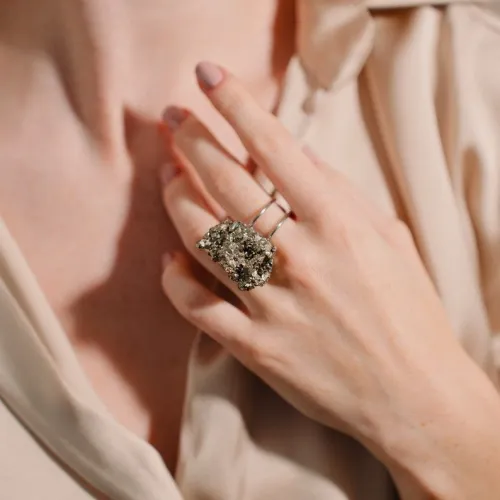
Whether you manage a university collection or private minerals, preservation differs for fracture-prone materials. Pressurized cleaning techniques risk creating new breaks, while improper storage induces surface degradation that obscures diagnostic characteristics. Mineral fragments recovered from rock slides tend to demonstrate cleavage absence more distinctly than pristine examples. When evaluating specimen quality:
Photography plays a crucial diagnostic role — lateral lighting emphasizes fracture topography on uncut specimens, helping identify pyrite when physical testing isn't practical. Museums often position specimens to display fracture complexity alongside crystal forms.
The structural traits influencing pyrite cleavage behavior also determine its industrial fate. Mining engineers consider fracture patterns when designing extraction methods, as pyrite deposits respond differently to blasting than cleavage-bearing minerals. In mineral processing plants, fracture characteristics impact how pyrite separates from ores during crushing. Understanding these fracture principles prevents unexpected fragmentation of valuable specimens during excavation and transport.

For collectors, fracture patterns often reveal authenticity — synthetics rarely replicate pyrite’s consistent conchoidal behavior. The mineral’s instability influences display decisions; UV-filtered cases slow tarnish development on fracture surfaces while keeping silica gel packets absorbed excess moisture that accelerates breakdown. Experienced buyers balance aesthetic preference against structural integrity:
What separates confident mineral identification from hopeful guessing comes down to structured observation. Start with core recognition methods like checking crystal angles with everyday items like smartphone measure tools. When examining specimens, note how light behaves differently on fracture surfaces versus weathered zones – photographing under varied lighting creates valuable reference documentation. Consider storing pyrite collections with humidity indicators to track preservation environments.
Build confidence through direct comparisons. Place pyrite near gold pieces to notice density differences. Hold fractured pieces and cleavage-minerals like calcite to appreciate different breaking behaviors. These tangible exercises transform textbook knowledge into practical instincts. With each interaction, pyrite’s fracture story becomes clearer than any cleavage plane could tell.
Why doesn't pyrite have cleavage like other cubic minerals?
Pyrite’s sulfur-iron atomic bonds distribute force equally in all spatial dimensions, preventing directional weakness where cleavage occurs. Unlike minerals with varied bond strengths, its uniform structure resists plane-specific splitting.
Can pyrite show cleavage under special conditions?
No confirmed conditions produce cleavage planes in pyrite. Its fracture remains consistent regardless of formation factors like temperature or pressure environments.
How do specimen collectors handle pyrite's fragility?
Handling by crystal edges rather than faces reduces fracture risk during examination. Display cases with vibration absorption and humidity control preserve specimens long-term.
Does fracture affect pyrite's industrial processing?
Conchoidal fracture patterns influence crushing behavior during mineral separation. This affects extraction processes compared to cleavage-prone ores that split differently under force.


$
