Pyrite's historical journey reveals a mineral that ignited civilizations as a primitive fire-starter, fascinated collectors with its golden deception, and now powers modern industries. Its unique crystal structure enables spark creation while its oxidation properties can deteriorate improperly stored specimens. Distinguishing pyrite from precious metals requires observing specific physical signs like streak color and fracture patterns.
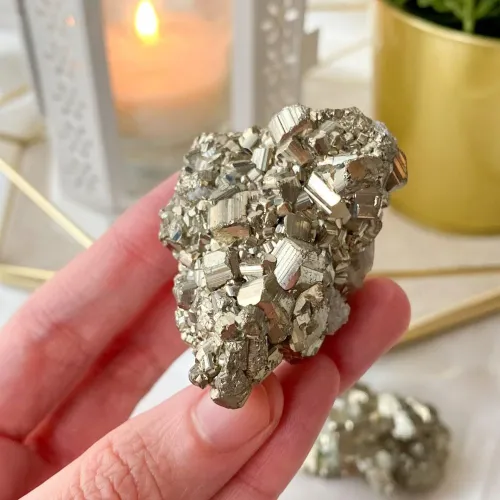
Ever held a brassy-yellow crystal that crumbled in your hand after mistaking it for treasure? You're following millennia of footsteps. Ancient civilizations carried chunks of iron sulfide to spark life into fires long before matches existed, while gold prospectors cursed its glittering deceit. This article traces pyrite’s dual legacy—how it enabled survival yet earned scorn as nature’s great imposter. Through documented field methods and historical accounts, we’ll explore its transition from indispensable ignition tool to geological prankster and modern science asset. Beyond the "fool’s gold" reputation lies a mineral with startling implications for archaeology, industry, and sustainable technology.
Primitive fire-making innovations across civilizations
Decoding mineral traits that aid visual identification
Medieval mining misconceptions fueling legends
Industrial processes harnessing pyrite compounds
Practical preservation strategies for collectors
Before flint-and-steel existed, humans leveraged pyrite’s unique structural properties. Early societies valued materials that could rapidly convert friction into thermal energy—a process where pyrite’s brittle crystalline lattice outperformed other stones. When planning wilderness expeditions today, understanding this mineral’s historical utility reveals why it appears near archaeological sites worldwide.
Sulfuric compounds within pyrite shatter unpredictably upon impact, creating tiny incandescent particles. Prehistoric cultures observed these sparks igniting dry tinder when struck against quartz or harder rocks—the earliest form of fire-starting "technology." Modern geology proves this property arises from pyrite’s anisotropic structure: its metallic atoms shear unevenly under pressure, releasing heat. Cave excavations across Europe uncovered groove-marked pyrite pebbles alongside charred remnants, suggesting systematic fire-production as early as 15,000 BCE. Unlike native copper or soft limonite, this mineral remained irreplaceable until the Iron Age.
Authentic prehistoric fire-starting pyrite displays signature parallel ridges. Archaeologists note that ancient artisans selected specimens exhibiting uniform striations—lines running parallel along crystal faces. Such features indicate stable pyritohedral formation, essential for spark predictability. Hold mineral samples against light while rotating to identify these rhythmic linear grooves distinguishing utilitarian pyrite from granular masses.
Successful identification prevents deceptive specimens from misleading contemporary collectors. Pyrite’s brass-toned surfaces often resemble gold under dim sunlight or sediment layers, particularly where crystalline structures form nugget-like masses. However, practical tests using household tools can unveil truths beneath the surface sheen.
Performing simple streak examinations exposes compositional differences immediately. Rub questionable specimens firmly against unglazed ceramic tiles: pyrite generates gritty, greenish-black lines due to its iron sulfide content, whereas gold leaves soft metallic streaks matching its yellow color. Crucially, pyrite’s brittle nature causes flaky fracturing under slight pressure—unlike gold’s malleable flattening when scratched. Mineralogists measure density discrepancies using water displacement jars; pyrite averages 5g/cm³ while gold occupies nearly four times heavier per volume. Three signal tests reduce misidentification risk:
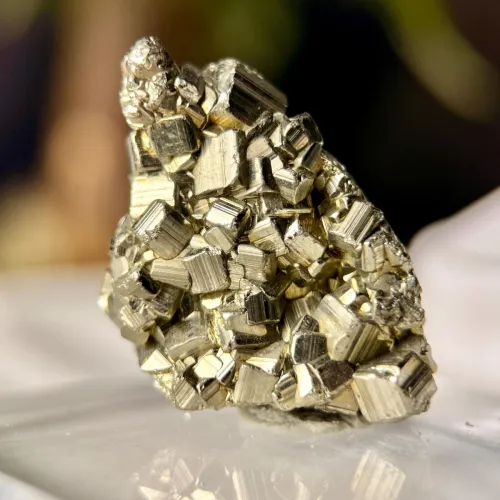
Pyrite’s reputation transformed during medieval economic booms as prospectors mistook disseminated deposits for lucrative gold veins. Germany’s Hartz Mountains in the 1500s witnessed frenzied excavations where miners nicknamed iron sulfides "Katzengold" (cat’s gold) upon discovering their worthlessness. This costly confusion arose partly because traditional spark tests proved unreliable in dim tunnel conditions.
Geological misunderstandings deepened cultural narratives. Alchemists attempted "transmutation" believing pyrite contained immature gold—a myth persisting until modern chemistry proved their elemental differences. Historical archives reveal miners ironically naming mines "Fool’s Fortune" after realizing their errors. Meanwhile, crystalline pyrite served artistic purposes: Incas polished reflective surfaces into ritual mirrors called "solar stones," while Victorian jewelers crafted "marcasite" adornments unaware of the mineral’s brittle instability.
Jewelry buyers should examine mount security and edge integrity before purchasing pyrite-adorned pieces. Look for micro-cracks radiating from sharp angles—indications inherent brittleness may cause crumbling years later. Museum conservators recommend avoiding ultrasonic cleaning since vibrations amplify lattice tension, hastening disintegration.
Contemporary pyrite usage leverages chemistry once considered undesirable. The sulfuric acid it releases during oxidation—a process long degrading museum collections—now facilitates fertilizers and chemical manufacturing. Through controlled reactions, iron sulfides concentrate metals like gold from ores during metallurgical processing.
Material scientists exploit pyrite’s semiconductor properties, synthesizing nanoparticles for low-cost solar panels. Ongoing research analyzes its catalytic potential in green energy systems where abundant iron provides cost advantages over rare elements. Pyrite’s conductivity also enables lithium-battery cathode innovations, reducing cobalt dependence. Contrary destroying historical artifacts, scientists now deliberately induce "fool’s gold" formation to capture soil contaminants, preventing heavy metal poisoning in agricultural areas downstream from mines.
Protecting specimens requires respecting pyrite’s reactive personality. Humidity triggers sulfuric acid formation as sulfur molecules bond with airborne moisture—effectively dissolving crystal structures over decades. Collections housing pyrite near carbonates see acid erosion etching adjacent specimens overnight. Smart collectors implement strategies combining micro-environment monitoring with isolation protocols. A 1400s astrolabe at Florence’s Galileo Museum offers caution: pyrite facets intended as decorative "gold" now exhibit crumbling disintegration necessitating painstaking restoration. Through careful observation and strategic actions, enthusiasts preserve pyrite’s historical narrative:
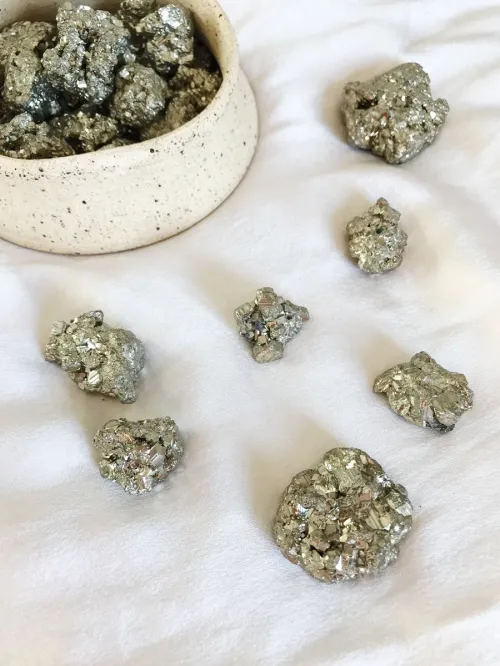
Pyrite’s journey teaches that perceived "failures" unlock unexpected understanding. A mineral dismissed by early miners now underpins sustainable technology, showing how time transforms disadvantage into advantage. When inspecting suspected "gold," recall medieval prospectors overlooking pyrite’s subtle signals: test streak patterns before trusting luster, feel for weight inconsistencies between same-size pieces, and listen for brittle fractures. Such attention could preserve discoveries—whether in ancient caves or modern electronics. Remember scientific observation often turns deception into discovery.
Q: Why didn't medieval miners consistently use streak tests to avoid pyrite confusion?
A: Underground darkness limited visual streak detection while inadequate ceramic tools prevented reliable comparison. Financial pressures sometimes encouraged wishful oversight despite observable differences.
Q: How should crumbling historical pyrite specimens be preserved?
A: Consolidation treatments using acrylic resins may stabilize pieces. Maintain stable low-humidity environments and isolate pyrite from sensitive minerals to prevent acid interaction damage.
Q: Is pyrite safe in closed terrarium ecosystems?
A: Over time, moisture-induced sulfuric acid may alter soil pH. Its leaching effect harms plants and organisms. Alternative decorations are advisable for biological environments.
Q: What visual differences distinguish pyrite from marcasite?
A: Marcasite crystals form radiating blades rather than pyrite’s cubes. Marcasite yellows faster when chemically exposed and feels less dense. Its structural instability requires extreme conservation care.


$
